
For women who want to make peace with their bodies and for the young women they love.


The Rewilding of the Shrew
Lets face it. As women, we have had a significant dumping of cultural expectations loaded onto us. We spend the first half of our lives contorting ourselves, starving ourselves physically and metaphorically, doing our best to meet the world's expectations of us. Essentially 'taming" us. Then at some point we hit a wall and really start to rethink our life choices.
I'm all about that particular moment because that is when there is a potential, a sniff of, the merest hint that a woman is on the verge of the possibility of a rewilding. A returning to her authentic vibrant nature.
However It feels like crap when we find ourselves, not in the middle of the herd, but somewhere out on the edges thinking..."WTF? This can't be right!" It is here that you begin to question the nicey nice parts of yourself and begin to learn to become shrewd, to learn the art of discernment. But without support, it can feel like you just backed up to a human-sized cheese grater wearing nothing but a thong and an embarressed smile while some cruel cherub tosses salt at you like it is confetti at a party. To mitigate the burn, it is important that you get a rewilded support shrew on your side.
A "shrew" historically, was a term heavily used to shame women who spoke up, refused to obey authority, or stepped outside traditional social roles (honestly that sounds like my kinda people).
I say, let's reclaim that word.
Because underneath it is the word shrewd. Having or showing sharp, practical intelligence and good judgment that results in advantage. To become shrewd is to develop discernment.
It is a journey to get there, and it often looks like this:
AUTOBIOGRAPHY IN FIVE CHAPTERS by Portia Nelson
I
I walk down the street.
There is a deep hole in the sidewalk.
I fall in.
I am lost … I am hopeless.
It isn't my fault.
It takes forever to find a way out.
II
I walk down the same street.
There is a deep hole in the sidewalk.
I pretend I don't see it.
I fall in again.
I can't believe I'm in the same place.
But it isn't my fault.
It still takes a long time to get out.
III
I walk down the same street.
There is a deep hole in the sidewalk.
I see it is there.
I still fall in … it’s a habit.
My eyes are open.
I know where I am.
It is my fault.
I get out immediately.
IV
I walk down the same street.
There is a deep hole in the sidewalk.
I walk around it.
V
I walk down another street.
My job is to help you find that street sooner rather than later.
Because that street leads you to your authentic self.
When we are young and we experience a trauma we often reject a part of ourselves. But often, it is one of the most authentic parts of ourselves expressing itself, and it bumps up against a person or system that feels threatened by it. So they seek to shut it/you down. Culture can do this, and so can others in our family or community.
To become truly shrewd, however, is to regather those lost parts of ourselves and alchemise the historical pain into personal power while you choose not a street but a whole new glorious wilderness to explore. When you choose to rewild your authentic self.
This is the point of Creative Somatic Ecotherapy which is the type of therapy I offer. I use mother nature as my cotherapist as well as your body which has taken the emotional hits and stored the stuff that was too hard for processing later. Later is now. And it is better out than in.

I began the search as a women's health nurse, right there between the legs of women while they were performing the miracle of birth, only to hear them lament in the not-so-distant future about the extra weight they now had to shed...
Then I became a body-positive photographer. Exploring the impact of the camera on our self-worth.
In 2017, my niece walked into my kitchen and asked me if she was fat. She was 5. I spit out my drink. Honestly what the ferk is a 5 year old doing worring about a thigh gap? I realised that I needed to up my auntie game quick.
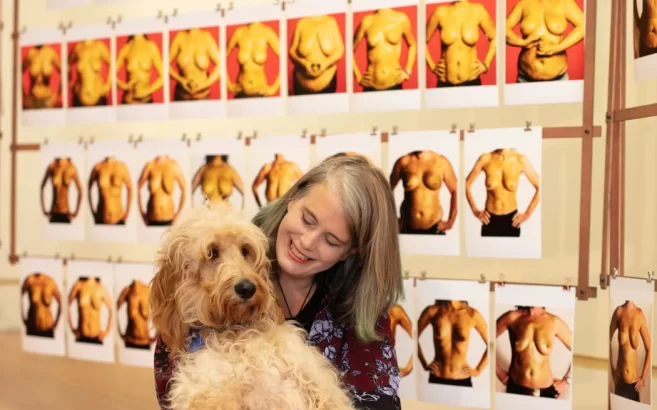
So I did what every quirky auntie did, and I got weird. I decided that I wanted to show her what real women looked like. The women I had witnessed for years performing miracles out of their girl parts did not look like the models in the billboard in the malls.
So I put a message out on facebook asking women to let me cover them in golden clay and photograph them. Hundreds said yes. Aged 18 - 80. I travelled New Zealand and California photographing gorgeous humans. And created an exhibition for my niece. That project became a film, and that film travelled the world, winning awards. I even gave a TEDx talk about it all.
I trained to be a youth worker in that time as well not sure if it was the chicken or the egg I should focus on.
I put on workshops while I was doing the photography and making the film, and it was wonderful, but it was missing something. My years as a nurse did not train me to work with such a complicated subject as the knotty issue that is body shame as effectively as I wanted to. The photography, the group work, the community, the youthwork they all helped and for some women that was enough, but for some they needed more.
I had never personally found that talk therapy did it for me. My issues were preverbal. I think I started absorbing body shame before I could talk. So talking about it wasn't scratching the itch. But you know what did? Somatic Ecotherapy. Actually working with the body to understand the body.
What sort of a therapist are you looking for?
Maybe you need a therapist to help you belly laugh so hard you have to wipe your eyes and catch your breath. One that can hold safe space while you ugly cry your way to your beautiful truth.
The truth that you are a gift to this planet. But that can be really hard to hear sometimes, even harder to believe it when you are carrying the weight of the world, and a sack full of historical traumas/dramas.
But let's be honest. If you are brave enough to even start the work to find your authentic gifts, that work can be tricky. So it helps to have skilled company that walks shoulder to shoulder with you and makes the journey more easeful, safer, and less painful. Kind of like a happiness sherpa.
One that can help you navigate out of the forever looping the same stories in your head. Someone who can show you the exit out of the brain, through the body.
All is welcome
Your darker places don't scare me. The parts of you that feel too much, too complicated, or too hard to explain. Those are welcome here, too. I have my own. And I have learned, they are simply guardians of our gifts. And they need to be deeply seen in loving compassion, not judgment, before they release their treasures.
I hope to come to know the nuance of you. All of you, the hot messes hidden in the spare room, and the button downed forward facing "winner" parts too. It is all welcome and all celebrated.
How I work
RITES OF PASSAGE
If you are standing at a threshold right now, wondering why it feels so hard, it may be because nobody ever showed you how to cross it. That is not a personal failing. It is a gap in what was handed to you. We can fill it.

About Me
A cheeky therapist who took the long way to her seat.
Fifteen years as a women's health nurse consultant, holding women at the most threshold moments of their lives. Fifteen years as a therapeutic photographer and filmmaker, using art to question the cultural stories women are handed about their bodies. Eight years as a youth worker, supporting at-risk young people through creativity, bushcraft, and rites of passage.
I've spent years studying Hakomi, nonviolent communication, ecotherapy, rites of passage, and bushcraft. Not collecting credentials. Assembling a very specific set of tools for a very specific purpose. To create containers for women's empowerment.
I use nature and creativity as my primary tools to support the shedding of what no longer serves you and growth into what was always there and needed support releasing.
When I am not working as a therapist, I work as an educator. I am helping to develop a new way of educating the whole child at Earth School Aotearoa.
And I am training teachers in using Nature and Neuroscience in their classrooms. Supporting teachers at risk of burnout find their way back to their passion and reintroducing them to the support of nature as a regulating tool in the classroom.
Press Coverage of my work:
Youth work:

Body Compassion work / Film Maker

https://www.thepost.co.nz/culture/350309689/mandi-lynn-wants-help-women-find-body-gratitude
